You may think you are no longer a watch newbie. Now that you can distinguish between mechanical and quartz watches do you feel a sense of pride? When you see new beginners do you feel an urge to share your knowledge about watches? However there are still some terms that are confusing. If you can master just these you will be able to talk about watches smoothly with your mom, Dad, Your girlfriend (who may not want to hear any more), And your boss who is always eager to show off his latest watch. That is why we are here to clarify these terms for you. A to Z of confusing terminology!
The Subtle Difference Between
Movement and Caliber
© Cartier
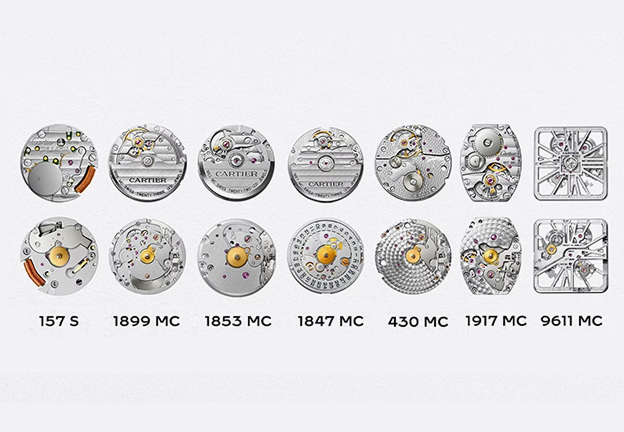
The movement of a watch is essentially its engine. It is the core mechanism that displays the time. Wristwatches are largely divided into mechanical and quartz types depending on how they operate. The former uses a mainspring as its power source while the latter uses a battery or capacitor. Although their power sources differ they both display time using a consistent vibration. In summary the movement is the engine of the watch and movements are classified as either mechanical or quartz.
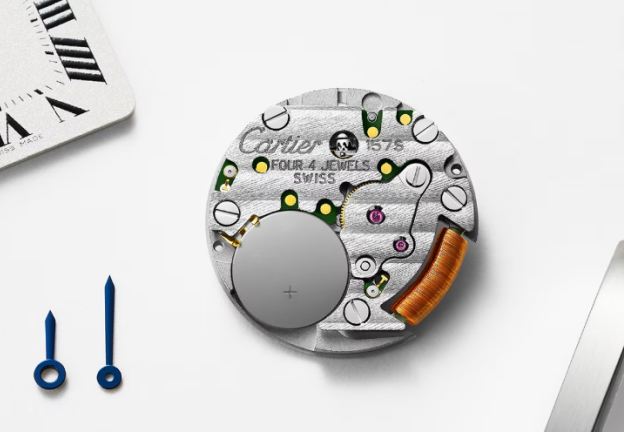
Quartz movements can usually
be identified by the presence of a battery and coil.
© Cartier
So what is a caliber? ‘Caliber’ often abbreviated as ‘Cal.’ is like the unique identification number or code of an engine. Just as Mercedes-Benz has the M256 engine and BMW has the S55 engine each watch brand has its own ‘engine’. For example Rolex Caliber 3235 and Omega Caliber 8800.
The term caliber was first used in 1715 by British watchmaker Henry Sully in France to describe the design layout and dimensions of a watch movement and has since become established in horology.
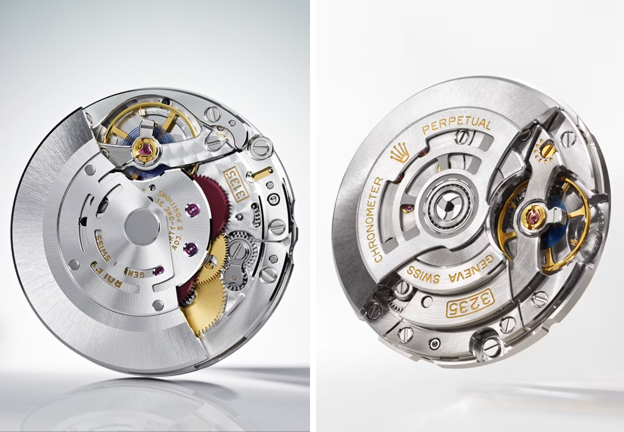
Rolex Cal. 3135 and Cal. 3235 / © Rolex
Later caliber came to refer to the specific design of a movement. The term ‘caliber’ also means the bore of a firearm such as .38 or .45 caliber. Since round movements also have a diameter some say that is why movements are called calibers.
Today the terms movement and caliber are not always strictly distinguished but the difference is whether it is the engine itself or its identification number. In any case knowing the caliber number allows you to determine whether it is hand-winding or self-winding how much power reserve it has and what functions are included.
Hand-Winding vs Self-Winding
What Is the Difference?
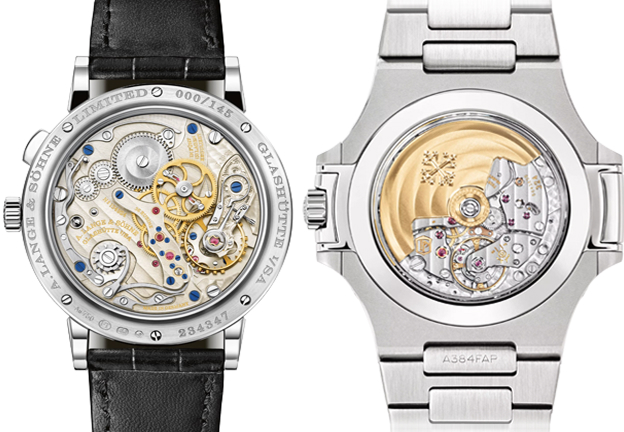
Left: A. Lange & Söhne 1815 / Right: Patek Philippe Nautilus
© A. Lange & Söhne, Patek Philippe
Hand-winding and self-winding refer to how the mainspring is wound in a mechanical movement. Hand-winding is also called ‘manual-winding’ and self-winding is called ‘automatic’. The difference lies in the presence or absence of a rotor which is the key device for winding the mainspring. Only self-winding movements have a rotor that winds the mainspring using the motion of the wrist. Most modern movements are self-winding. Since you can distinguish them by the presence of a rotor you can easily tell by looking at the see-through case back. However there are some movements that can be confusing.
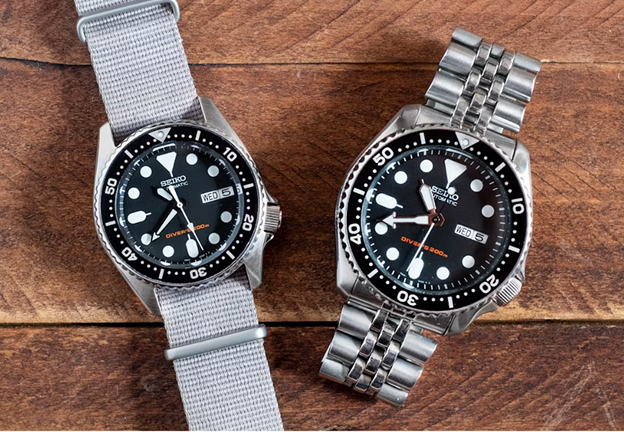
SKX007 and SKX013, Watches with many memories for enthusiasts.
What is special about their movements? / © Hodinkee
This refers to self-winding movements that do not support hand-winding. In other words you cannot wind the mainspring using the crown.
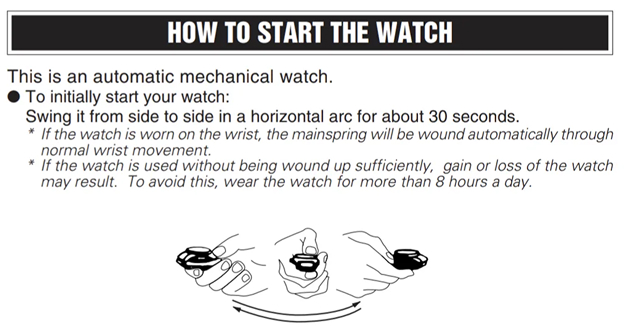
If you own a Seiko you may have experienced this movement.
The mainspring can only be wound by motion / © Seiko
Self-winding usually supports manual winding as well but there are rare exceptions which can blur the distinction between the two. However most luxury watches with self-winding mechanisms today have addressed this inconvenience so confusion is rare.
In-House and Manufacture
You may have seen the phrase ‘in-house movement produced by a manufacture’. This means a proprietary movement made in the brand’s own factory. While this seems straightforward the reality is a bit more complex. Generally ‘manufacturer’ refers to a company that mass-produces products. However in the watch industry it is used differently. It refers to a company that has the capability to produce watches entirely in-house.
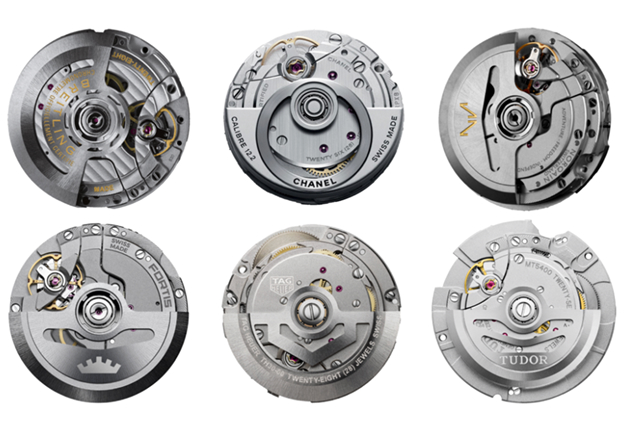
What do these movements have in common? / © Time + Tide
There has been debate over how much of the production must be done in-house but generally if a company can make its own in-house movement it is recognized as a manufacture.
Although there is debate about the scope of in-house production in general to be recognized as a manufacture a company must be able to produce its own in-house movement. For example Tudor assembles and inspects its watches but relies on Kenissi for movement production.

Red wing (Tudor) handles final assembly and inspection
Gray wing (Kenissi) produces the movement / © Tudor
Although there is debate about the scope of in-house production the key criterion is exclusivity. If a movement is made exclusively for one brand it is generally recognized as an in-house movement.
Breitling shares movements with Tudor in some models and TAG Heuer uses movements made exclusively for the brand by Kenissi such as the TH30-00 in the Aquaracer Superdiver. Chanel acquired a 20% stake in Kenissi in 2018 and although the Kenissi factory is located right next to Tudor’s in Le Locle Switzerland some movements made exclusively for Chanel are called ‘manufacture movements’.
As a result the formula ‘in-house movement ≓ manufacture’ is established. However purists argue that a true manufacture should make not only the movement but also small parts like hands and screws in-house. By their standards only a handful of watch companies qualify as true manufactures. Representative manufactures include Rolex Patek Philippe A. Lange & Söhne Jaeger-LeCoultre Audemars Piguet Omega and IWC.
Accuracy VS Precision
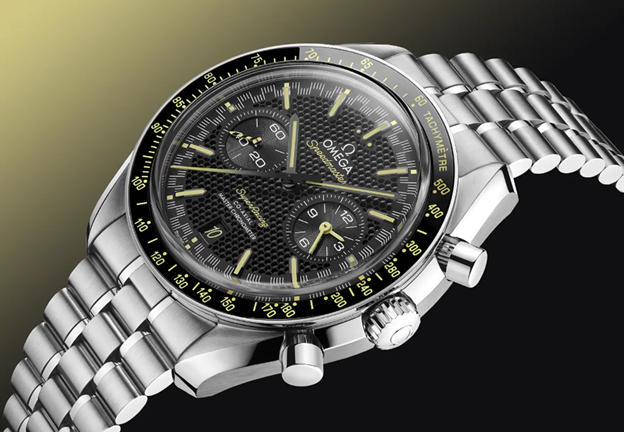
Speedmaster Super Racing
Equipped with Omega 9920 with Spirate™ system for ultra-fine rate adjustment (0/+2 sec/day) / © Omega
Accuracy refers to how closely a watch displays the actual time. For example if a watch gains an average of +3 seconds per day it means it runs 3 seconds faster than the actual time. Precision on the other hand refers to how consistently the watch keeps time. A precise watch may not be accurate but it will consistently run fast or slow by the same amount each day. The example of a watch with an average daily deviation of +3 seconds means it is both accurate and precise. Does this remind you of ‘zeroing’ in shooting practice?

© Tetravision
For example if a watch loses an average of -10 seconds per day its accuracy is low but its precision may not be bad since it is consistently off by -10 seconds each day. In this case correcting the deviation will improve its accuracy. These terms are similar and depending on the watch’s deviation accuracy and precision may or may not be the same so it is easy to get confused.
Water Resistance
Meter (m), Bar (bar), Atmosphere (ATM)
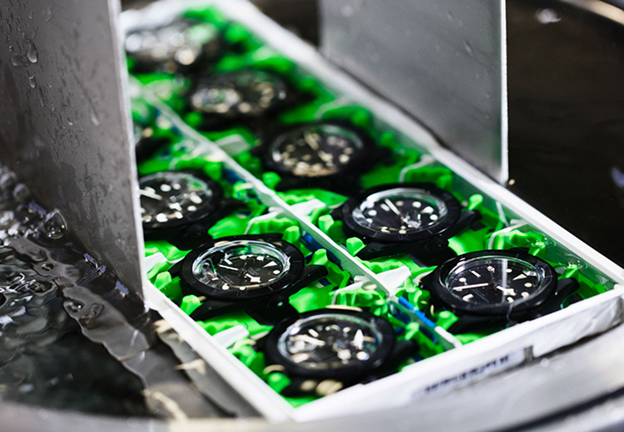
© Tudor
When indicating water resistance meters are commonly used. As a result ‘100m water resistance’ is often misunderstood as being able to withstand a depth of 100 meters. However 100m water resistance means the watch can withstand the pressure equivalent to a depth of 100 meters in still water. In rough water or strong waves the water resistance can be significantly different.
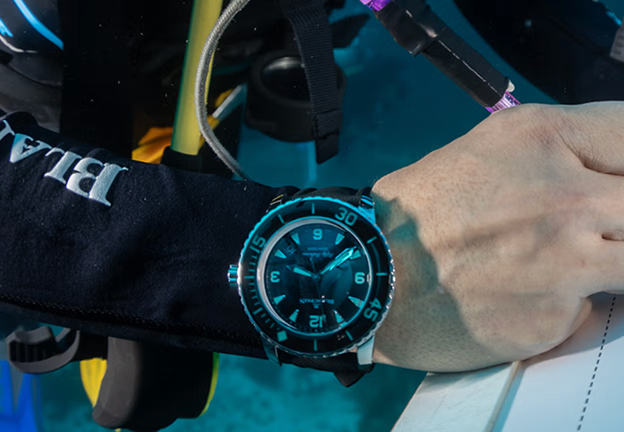
© G Studio Limited, Blancpain
In addition to meters water resistance is also indicated in bar or ATM. ATM stands for ‘atmospheres’ which refers to the pressure a watch can withstand. Generally 100m water resistance is equivalent to about 10 bar or 10 ATM. You can simply remove the last zero from the meter value to convert so it is easy to estimate water resistance. 1 ATM is 1.01325 bar but in practice exact values are not always used.
Oh right I almost forgot about feet. Feet are usually indicated together with meters and you can easily convert using various unit converters.
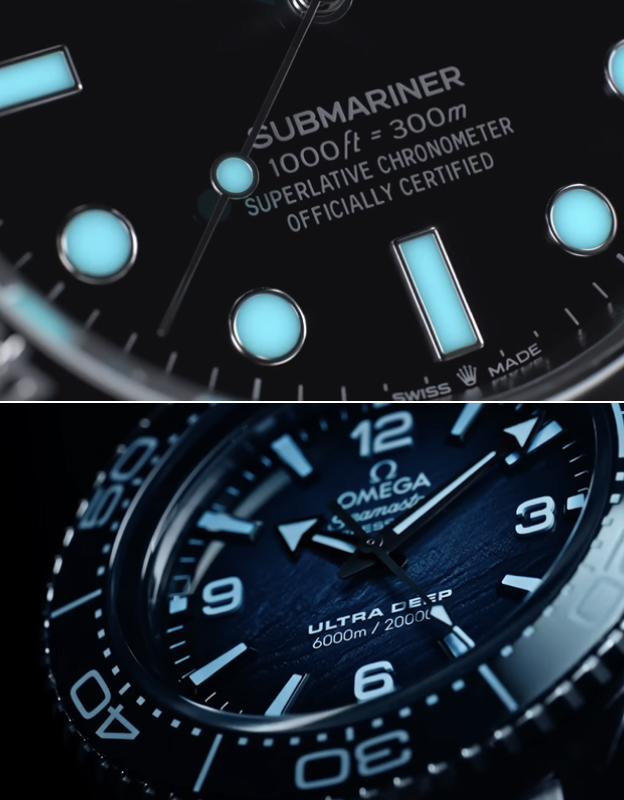
Submariner and Seamaster with both meters and feet indicated
© Rolex, Omega
A New Unified Water Resistance Standard?
In 2024 Patek Philippe announced a new ‘unified water resistance standard’ in a press release. This means that 30 meters is not just enough to withstand raindrops but is a ‘true depth rating’ that can actually withstand 30 meters of depth. It will be interesting to see if this change affects how other watch brands indicate water resistance ratings.
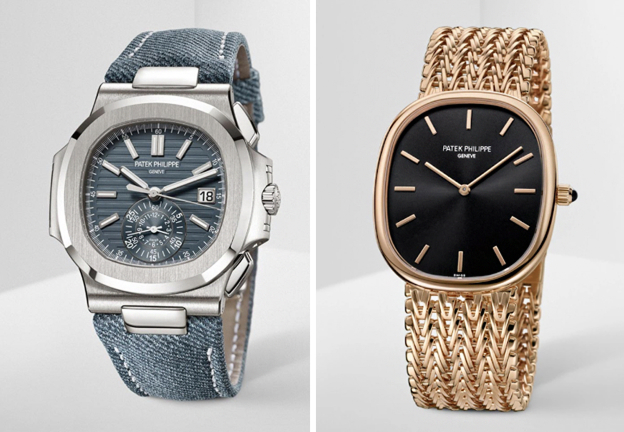
Currently in the Patek Philippe catalog the Nautilus and Golden Ellipse
offer essentially the same water resistance. / © Patek Philippe
Here is an excerpt from the actual press release (translated):
Patek Philippe has introduced a unified water resistance standard based on 30 meters for all watches certified for water resistance to ensure consistency and clarity of information provided to customers. This standard is based on tests conducted at an overpressure equivalent to 3 atmospheres (about 30 meters depth) both in air and underwater. This ensures that all models provide the same water resistance and customers can be clearly informed that they can safely enjoy everyday water activities such as hand washing, Showering, Bathing, Swimming, And diving up to 30 meters while wearing their watch.
Felix
Writer
Watch Columnist