Not all gold is the same gold. Not all steel is the same steel and the same goes for titanium. Some readers may think, "But isn't all gold different to begin with?" It is true that they are different. White gold, Yellow gold and red gold all have different colors. However, Aside from the color, The basic material that makes up gold is the same. The ones who claim "not all gold is the same" are the watch companies themselves. This is because they actually use different material combinations from traditional gold. Let us now enter the world of 21st-century alchemy as presented by watch brands.
Confusing Proprietary Names
When you look at the name or spec sheet of a watch, You may see indications like Sedna™ Gold (Omega) or Ceratanium® (IWC). The small ™ means a trademark and the circled ® means a registered trademark. There is a difference in legal protection, But both symbols commonly indicate 'uniqueness.' In other words, It is a way of saying, "This is unique to us, So no other watch company has the same thing."
Such claims by watch companies are part of a brand differentiation strategy. They want to emphasize their own uniqueness to increase sales. Mechanical watches are limited by the use of springs and gears, So they cannot use innovative technologies like quartz. Although new functions are continuously being developed, Due to their special nature, It is not possible to use features or technologies that would change the paradigm. In this context, Materials have come to be noticed as a way to show 'novelty.' As a result, Uniqueness is being infused not only into functions but also into materials.
Replacing Traditional Gold
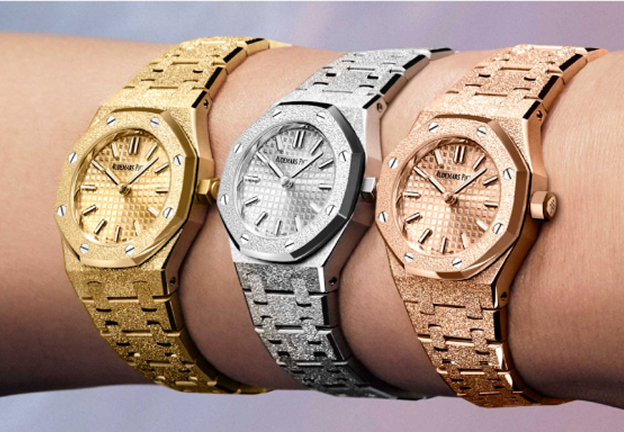
Royal Oak Mini in yellow, White and pink frosted gold
© Audemars Piguet
The element that can elevate accessories to luxury is, Above all, Gold. Traditionally, High-end watchmakers have chosen gold cases. The number '750' engraved on the caseback of these watches means it is made of 18k gold. The reason for using 18k gold is that its hardness and workability are suitable for making cases. Gold is 75%, And the remaining 25% is made up of materials such as silver and copper to create a gold alloy. The color of the gold is determined by the composition of this 25%, Resulting in white, Yellow and red gold.
It would be nice if gold cases made this way could last forever, But that is not the case. Discoloration can occur, To the point where the expression 'faded' is quite accurate. This phenomenon is particularly noticeable in rose and red gold. Because of this, Watch companies have wondered if the brilliant color of gold could be preserved longer, And as a result, Modern alchemy has led to the development of new forms of gold.
Everose Gold
A leading example is Rolex, The master of marketing. Rolex, Which has long enjoyed giving names like Rolesor to gold and steel combinations, Gave the name Everose to its newly developed proprietary red gold alloy.
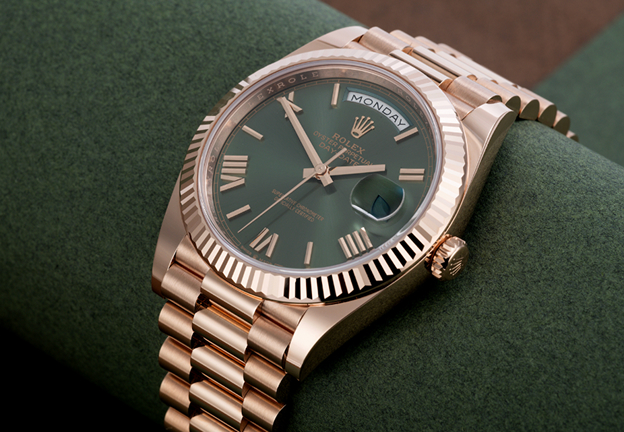
The 60th Anniversary Day-Date, Which has been popular since its launch in 2016
Ref. 228235 / © Watch Club
As the color of red gold tends to fade over time, Rolex chose the name 'Everose' to symbolize a rose gold (a less red shade among red golds) color that lasts longer.
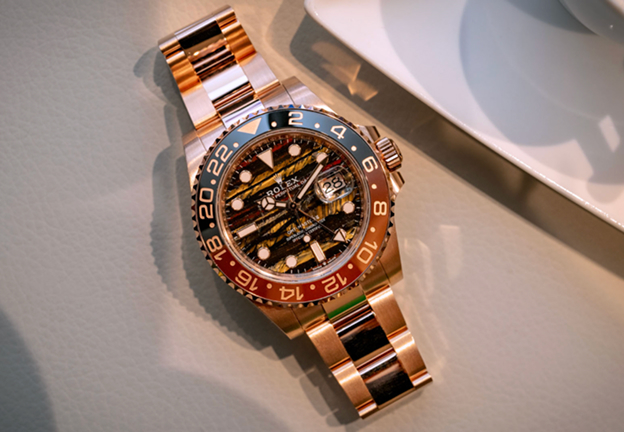
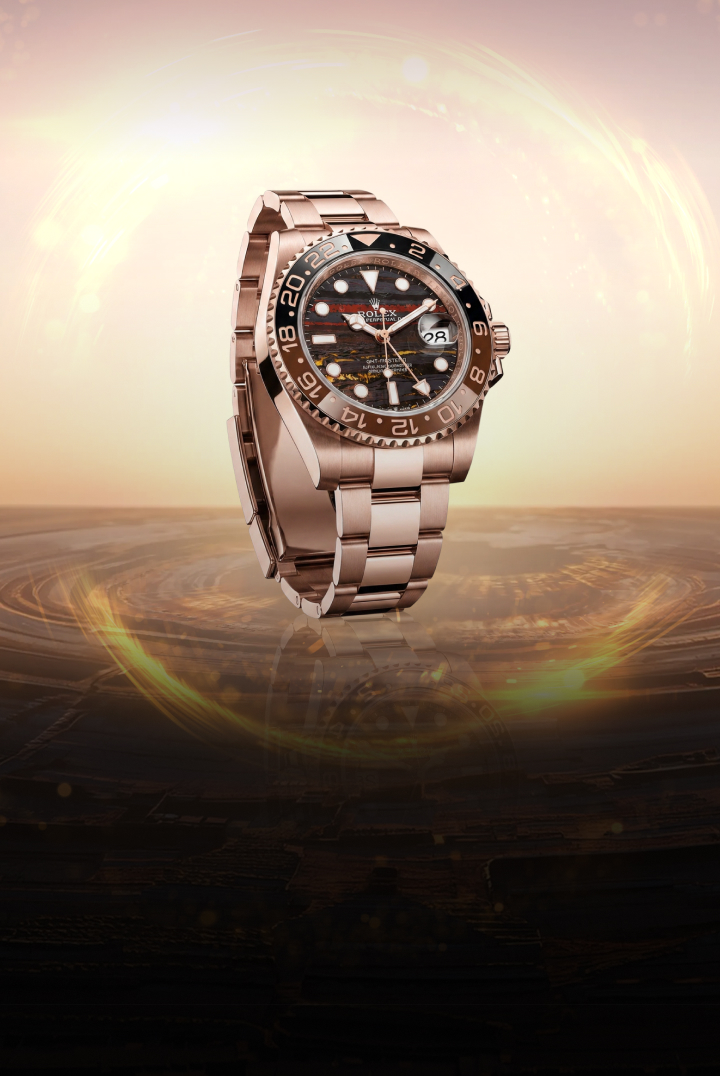
GMT-Master II 'Root Beer' with tiger iron dial
© A Blog to Watch
Rolex is known to use a proprietary blend that adds platinum, Which is resistant to corrosion and chemicals, When making Everose gold. The detailed recipe for this alchemy is kept secret and is protected by patents. As a company that refines its own gold, It was able to create its own unique gold. When Everose gold first appeared, Perhaps it was just my impression or memory, But it seemed even redder than now, Almost like copper.
Omega's Moonshine™ Gold & Sedna™ Gold
To be honest, Omega's moves are hard to explain without referencing Rolex. This influence can be seen in the development of proprietary alloy materials, With Sedna™ Gold and Moonshine™ Gold as representative examples.
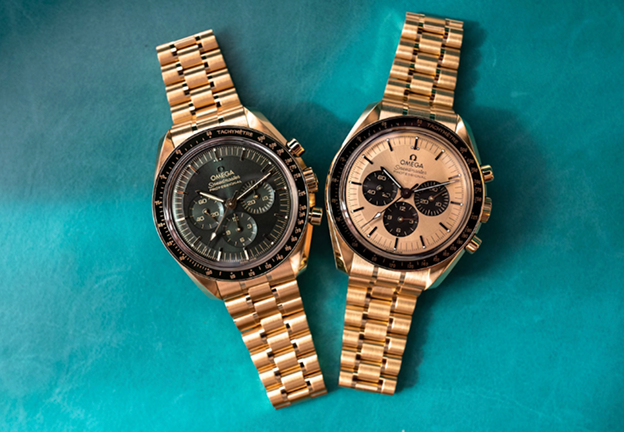
Two versions of the Moonshine Gold™ Speedmaster / © Hodinkee
The names are quite impressive. The name 'Sedna' was inspired by the brand's Constellation collection and is named after Sedna, A trans-Neptunian object in the solar system. It is said to be a star with a reddish color, Like Mars. To create this new gold, Omega is known to have used some palladium, But the exact blend is not disclosed (the known materials are yellow gold, Copper and palladium). Sedna gold, Completed through a special cooling process, Is said to be harder and able to maintain its unique color longer than traditional gold materials.

Speedmaster Moonwatch Professional 310.60.42.50.10.001
42mm, Green

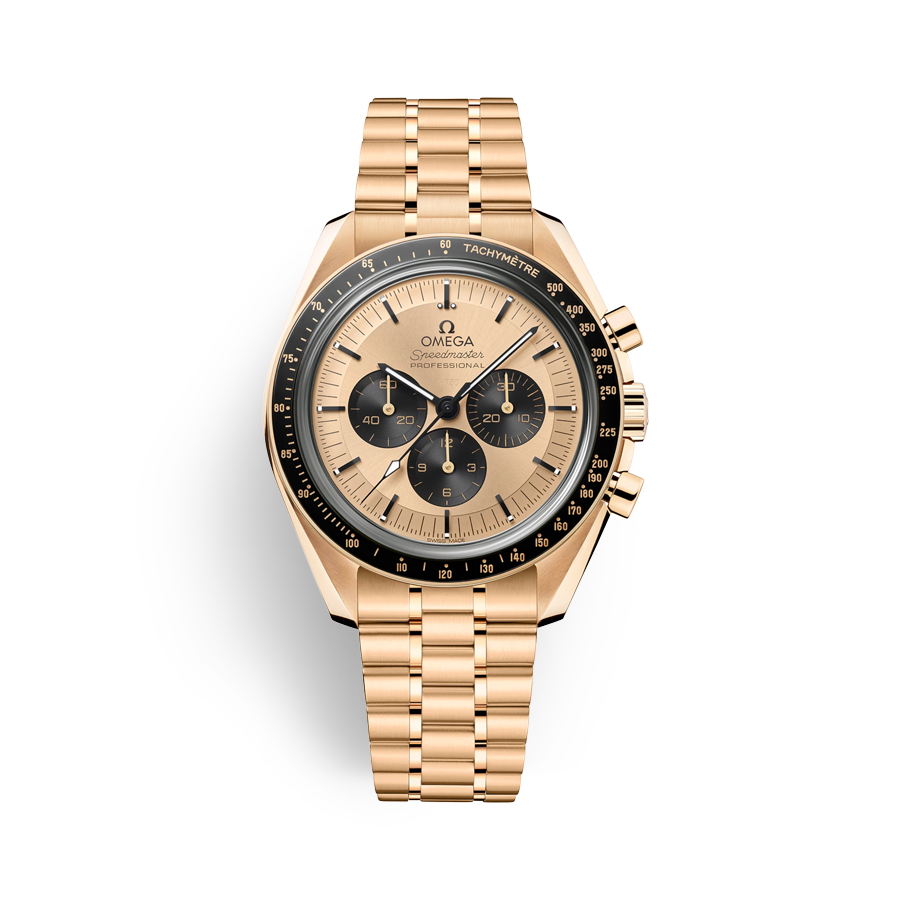
Speedmaster Moonwatch Professional 310.60.42.50.99.002
42mm, Yellow
There is also Canopus™ Gold, A white gold variant.
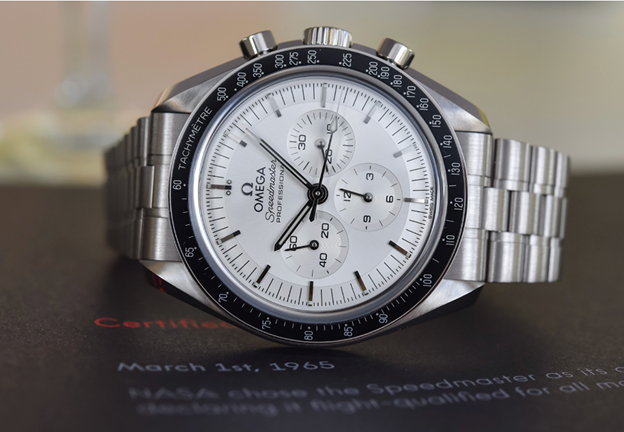
© Monochrome
What about other brands?

Armor Gold® mainly used in grand complication watches
© IWC Schaffhausen
IWC's Armor Gold® is, As the name suggests, A hard gold. It has the color of traditional red gold, But with a unique recipe and patented processing method, its structure is improved to boast much greater hardness and wear resistance than conventional 5N gold (source: IWC).
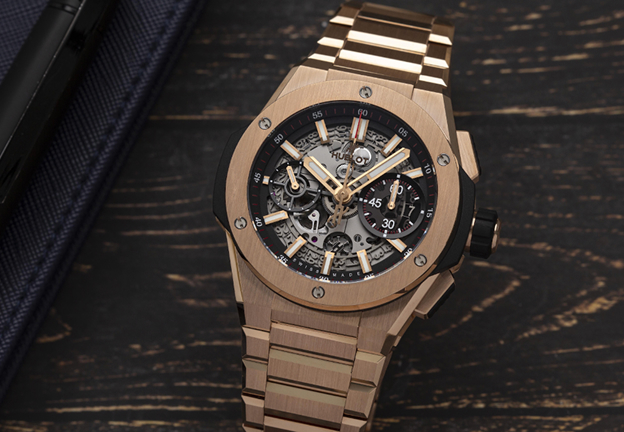
Big Bang Integrated King Gold
© Time+Tide
Hublot's King Gold took a similar approach to Armor Gold. However, It used even bolder secondary materials. For the 25% non-gold component of 18k gold, Ceramic was chosen. By pouring gold into porous ceramic, A powerful gold was created. This led to debates about whether it was truly gold, But it was recognized as gold by the Swiss Precious Metals Control Bureau (Bureau Central du Contrôle des Métaux Précieux).
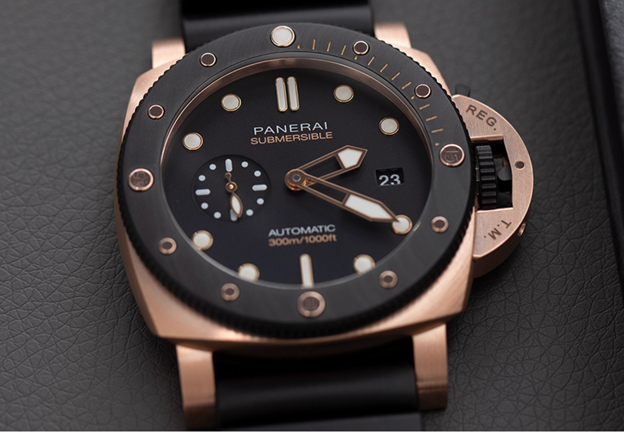
Submersible PAM01070 with Goldtech™ case
© Swisswatches Magazine
Other examples include Panerai's Goldtech™, A new type of gold. Goldtech™, Which has a stronger reddish hue, Also improves on the weaknesses of regular red gold, Such as color fading and softness.
Other Materials
The following are results of fusing various materials or creating entirely new ones. IWC's Ceratanium® was created by fusing ceramic and titanium. It features the mechanical properties of metal and the surface characteristics of ceramic. It has the strength of a fusion between Son Goku and Vegeta from Dragon Ball Z. It is an ideal material that combines the lightweight and strong durability of titanium with the high surface hardness and wear resistance of ceramic.

Pilot's Watch Chronograph 41 Top Gun with Ceratanium® case,
Performance Chronograph 41 / © Monochrome
Thanks to its excellent durability and scratch resistance, Ceratanium® is specialized for sports-themed models. So far, It is only used in the Pilot's Watch and Aquatimer lines and is mainly applied to experimental performance watches.

Big Pilot's Watch Shock Absorber XPL Tourbillon Skeleton
© IWC Schaffhausen
Next is Bulk Metallic Glass (BMG), Which may be unfamiliar even to enthusiasts. BMG is a special alloy that is amorphous like glass but has the hardness and durability of metal.
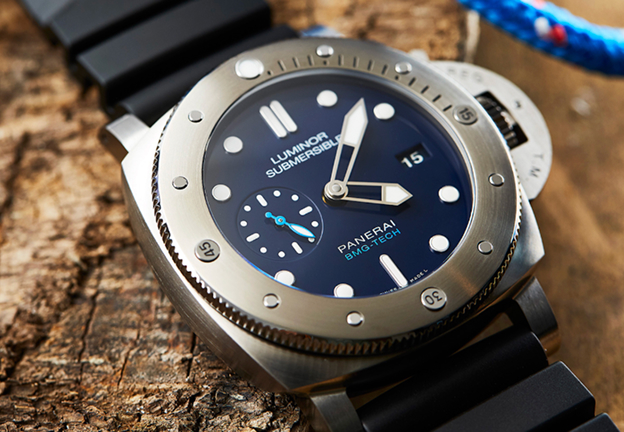
Submersible BMG-Tech PAM00692 / © Time+Tide
Panerai's Submersible BMG‑Tech™ is considered the first commercial example of applying bulk metallic glass to a watch case. It is lighter than conventional titanium, Highly resistant to scratches and shocks, And shows excellent resistance to corrosion. Perhaps because it requires advanced processing, It can only be found in some models.
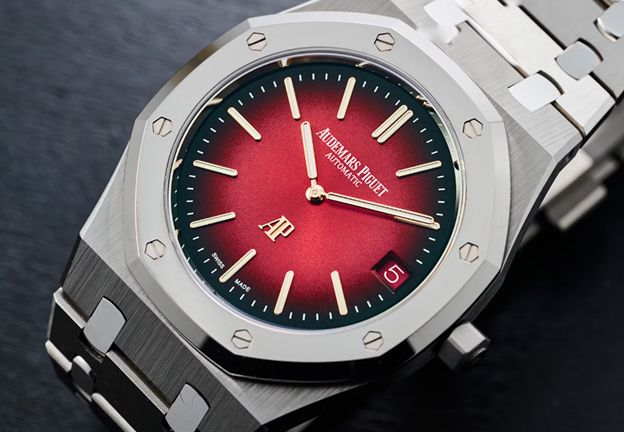
Royal Oak 'Jumbo' 16202XT / © Hodinkee
The Royal Oak 'Jumbo' Extra-Thin 16202XT, Released in 2023, Features a unique case structure that combines titanium and BMG. The parts where BMG is used are the bezel, Caseback and bracelet studs (not the entire bracelet, Only the studs). The surface has a subtle sheen compared to regular titanium and boasts a texture that is as smooth as glass yet retains the hardness unique to metal.
Felix
Writer
Watch columnist